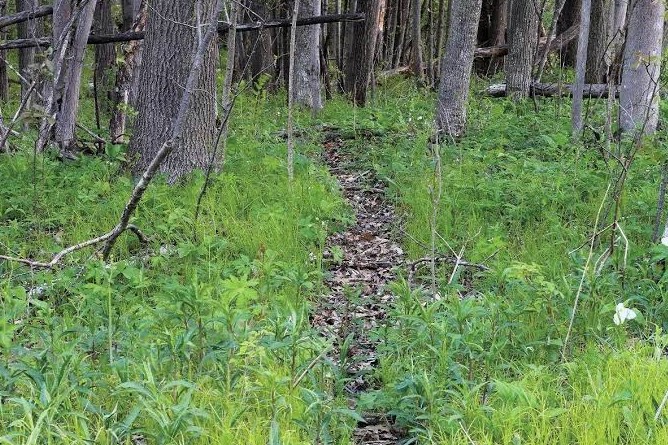
Deer sign proves a deer was there. It does not tell you when it will be back, and most scouting mistakes start with that confusion.
Why does fresh sign fool so many hunters?
Because fresh proves presence, not pattern. A trail that is hammered in August can be dead by the first week of November.
Deer change what they eat, where they bed and how far they travel three or four times between summer and the end of the season. A trail worn six inches deep in green timber is a record of a food source that will not exist once the frost hits. You are reading last month’s newspaper and planning next month around it.
This is the single most useful idea in scouting, and it is why we organise everything here around the phases of the deer season and how deer behaviour changes through them. Sign only means something once you know which phase produced it.
Rubs, scrapes and beds: what each one is worth
Each type of sign answers a different question. Confusing them is how hunters end up sitting over the wrong thing for a week.
| Sign | What it proves | Useful window | What it does not tell you |
|---|---|---|---|
| Track | A deer passed here | Hours to days | Size, sex or whether it returns |
| Rub | A buck worked this stem | Weeks | The time of day he did it |
| Scrape | Social hub, often at night | Days during pre rut | That he will visit in daylight |
| Bed | Cover and wind worked here | Season long | Whether it is still in use |
Beds are the most underrated of the four. A bed tells you what the deer wanted from that spot: wind at his back, a view downhill, thick stuff behind him. Those requirements do not change much even when the deer does.
- A rub line that climbs a ridge is usually travel, not territory
- Scrapes under a licking branch get used by several deer, not one
- Beds in groups mean does and fawns, single beds well off a trail usually mean a mature buck
Expert tip from Nathan Kestler, Big woods editor: “Sit down in a bed before you decide what it means. From down there you see exactly what the deer could see, and half the time that explains the whole setup.”
How old is that track?
Aging a track is guesswork with rules. You are reading how much the ground has moved since the deer left, not the track itself.
- Look at the sharp edges of the print. Crisp walls mean hours, crumbled walls mean days.
- Check for debris inside the print: a leaf or a needle that fell in puts a clock on it.
- Compare it with a print you make yourself, right beside it, and watch how yours behaves over an hour.
- Note the weather since the last rain. Everything before that rain is gone, so anything you see is newer.
Expert tip from Curt Bellamy, Public land editor: “Make your own print next to the one you are studying. It is the only calibration you get, it costs nothing, and after a season of doing it you will stop guessing.”
Reading sign as a system
One piece of sign is an anecdote. Three pieces that agree on a direction of travel are information.
Think of it the way a mechanic listens to an engine. One odd noise means nothing on its own. The same noise under load, at the same point in the rev range, three times, is a diagnosis. Sign works identically. You want repetition and agreement before you commit a stand site to it.
This is also where a camera earns its keep, because it puts a timestamp on everything you guessed at. We wrote about where to hang a trail camera on heavily hunted public ground, and about how those photographs change your reading of a rub line.
What to do with what you found
Convert sign into questions, not conclusions. Then go answer the questions.
- Mark every piece of sign with a date, not just a pin on a map
- Write down the wind you had when you found it, because you will not remember
- Come back three weeks later and see which of it is still being used
One October Curt marked eleven rubs along a bench and set up on the heaviest cluster. Nothing moved through for four days. He moved 300 yards to a single bed on a finger ridge with almost no sign around it, and killed a buck the next morning. The rubs were real. They were also three weeks stale.
Public land editor
Curt Bellamy
Thirty one years as a range technician on Utah public land. Mule deer, high benches, and a paper notebook he refuses to give up.