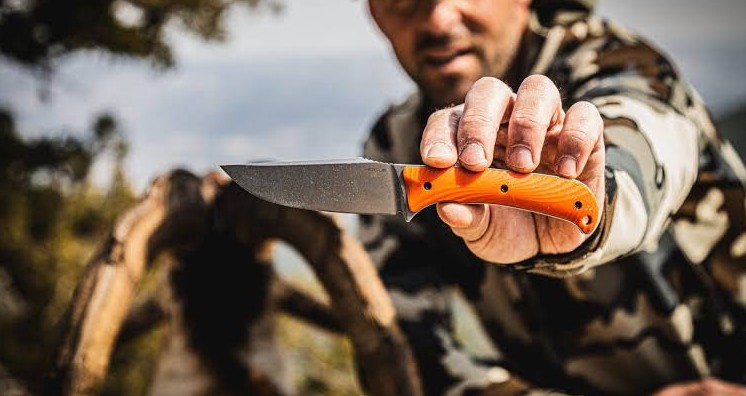
Field dressing is a sequence, not a race. Do it in the wrong order and you spend the next hour cleaning what you contaminated in the first two minutes.
Why does order matter more than speed?
Because almost every problem with meat comes from something being opened before it was moved out of the way. Sequence prevents that. Speed does not.
The gut cavity holds everything you do not want on muscle. Hair carries the rest. A hunter working fast and out of order will nick a stomach, then wipe it with a hand covered in hair, then keep going. The meat is not ruined, but it now needs washing, and washing meat in the field creates its own problems.
Working in order costs perhaps five extra minutes and removes most of that risk. It also means you can stop and think without losing your place.
Before the first cut
Three decisions, made standing up, before the knife comes out of the sheath.
- Where the animal will lie: head uphill if there is any slope at all
- Where you will put the meat: something clean, even if it is only the inside of a pack liner
- Whether you are dressing it here or moving it fifty yards to somewhere flat and shaded
Gravity is the only free help you get. An animal with its head uphill drains away from the muscle you care about most, and the gut cavity opens away from you rather than onto your boots.
Expert tip from Delia Rourke, Field care editor: “Take the two minutes to reposition the animal. I have never once regretted dragging a deer twenty feet to flat ground, and I have often regretted not doing it.”
The sequence
Five steps, in this order, every time. The order is the whole method.
- Open the hide from sternum to pelvis with the blade edge up, lifting the skin away from the guts as you go.
- Free the diaphragm and reach forward to release the windpipe as high as you can reach.
- Roll the whole gut pile out downhill, rather than lifting pieces of it out one at a time.
- Split or work around the pelvis, depending on how you intend to carry the animal out.
- Prop the cavity open with a stick and get air moving through it while you deal with everything else.
Step five is the one people skip and the one that matters most. A cavity that is propped open and shaded loses heat several times faster than one lying closed against warm ground.
What actually spoils meat?
Heat and time, in that order. Bacteria on the surface are a manageable problem. A carcass that stays warm in the middle is not.
| Mistake | What it costs you | How to avoid it |
|---|---|---|
| Leaving the cavity closed | Heat stays in the deep muscle | Prop it open, get airflow through |
| Dressing on warm ground | The lower side cooks against the dirt | Move it, or roll it after twenty minutes |
| Washing meat in the field | Wet surfaces hold bacteria longer | Wipe with a cloth, dry it, leave it dry |
| Sealing it in plastic | No evaporation, temperature climbs | Use breathable game bags |
| Photographs first | Twenty minutes of nothing happening | Dress it, then take the photographs |
Delia’s rule is simple enough to remember at the end of a long day: hide off, meat cooling, everything social afterwards. Congratulations keep. Meat does not.
Expert tip from Curt Bellamy, Public land editor: “In warm early season country I carry a lightweight tarp for shade before I carry anything else. Shade is worth more than any gadget in the pack.”
Getting it cooled and out
The goal is airflow on all sides as soon as possible, whether that is a quartered animal in game bags or a whole deer hanging in the shade.
Quartering in the field is not just for backcountry hunts. Four pieces in breathable bags cool far faster than one whole animal, and they are easier to carry in stages if you are alone.
- Breathable game bags, never plastic
- Shade first, then airflow, then everything else
- Quarters cool far faster than a whole animal, even on a short pack out
None of this works with a dull or badly shaped blade, and the pelvic work in particular punishes the wrong tool. What matters in a knife for this job is covered in blade length, grind and steel for a deer knife.
Field care sits at the end of a long season, and how you get there changes what you are dealing with. The whole arc is in our guide to the phases of the deer season.
Field care editor
Delia Rourke
Eleven years as a large animal veterinary technician before she wrote a word. Coues deer, and no patience for wasted meat.