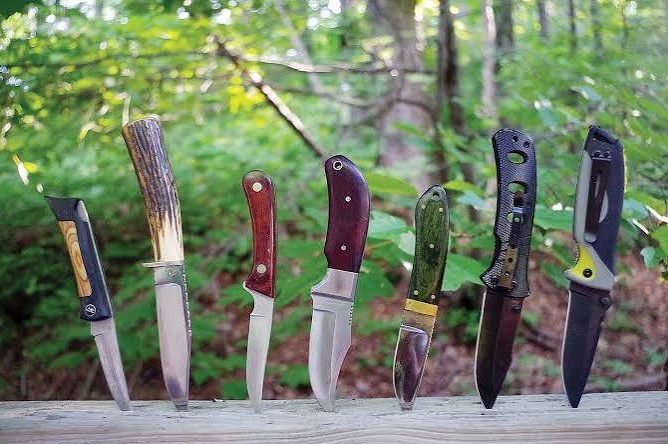
A deer knife is a small tool doing precise work in bad conditions. Blade length, grind and handle decide far more than the steel written on the box.
How long should a deer knife be?
Shorter than most people buy. Three to four inches handles every job on a deer, and control gets worse past that.
The work is close and mostly blind. You are cutting inside a cavity, against the pelvis, around joints, often with one hand doing the feeling and the other doing the cutting. A long blade gives you nothing there and takes away the ability to feel what the tip is touching.
Six inch blades sell well because they look serious on a table. Watch what people actually reach for on the third animal of the season and it is almost always the small one.
- Three to four inches covers dressing, skinning and quartering on any deer
- A short belly and a fine point make the pelvic and caping work possible
- A blade you can choke up on is worth more than an extra inch of edge
Grind: what the cross section actually does
The grind is the shape of the blade behind the edge, and it decides whether the knife slices or wedges.
Think of it like tyre profile. Two tyres can have identical tread and behave completely differently because of what is underneath. A thick saber grind wedges through hide and tires your hand. A thin flat or scandi grind parts it and keeps going.
- Flat grind: thin behind the edge, the safest all round choice for deer
- Scandi grind: excellent at slicing hide, easy to sharpen against a flat stone
- Saber or thick hollow grind: strong, but it wedges in hide and tires your hand
For deer, thin behind the edge beats hard steel almost every time. You are cutting soft tissue and hide, not chopping.
Does the steel matter as much as people say?
It matters, but less than the internet suggests, and always as a trade. Every steel buys edge holding with something else.
| Steel | Edge holding | Toughness | Rust resistance | Sharpening in camp |
|---|---|---|---|---|
| 420HC | Modest | High | High | Very easy |
| 440C | Moderate | Moderate | High | Easy |
| D2 | High | Lower | Moderate | Hard |
| S30V | High | Moderate | High | Hard |
| CPM 3V | High | Very high | Moderate | Hard |
| 1095 carbon | Moderate | High | Low, it will rust | Very easy |
Read that table as a set of compromises rather than a ranking. A hunter who sharpens well and works two animals a year is better served by 420HC that comes back in six strokes than by a powder steel that needs diamonds and twenty minutes.
Expert tip from Delia Rourke, Field care editor: “The steel question is usually the wrong question. I would take a well shaped 420HC blade over a badly ground S30V one on any animal, any day.”
Handles, and the thing nobody tests
Every handle works in a shop. The test is whether it works wet, cold and covered in fat, which is the only condition that matters.
Slick polished wood and smooth aluminium both become dangerous in that state. Texture, a bit of palm swell and a guard or a solid finger choil are what keep your hand off the edge when the blade suddenly frees up and moves.
- Hold it with a wet hand before you buy it, or at least with a wet glove.
- Push on the spine hard with your thumb and see whether the grip rolls.
- Check that you can choke up to the point without your fingers reaching the edge.
- Look at how the sheath carries, because a knife that is awkward to reach gets left in the truck.
Expert tip from Nathan Kestler, Big woods editor: “Handle first, steel last. Cold hands at nine at night, three miles from the truck, is when you find out whether the shape was right.”
What we actually carry
Between the three of us: two small fixed blades and one folder, all under four inches, none of them expensive by collector standards.
Curt used one drop point for twenty years and more than a hundred animals before the blade got too short to be honest. Delia carries a short, fine pointed fixed blade and a separate small saw. Nathan carries a folder because he is often cruising timber when he finds himself unexpectedly hunting.
This is also where custom knives make sense to us. A maker who grinds for game rather than for a display case can put thin geometry and a real handle on the same tool, which is a combination that mass production rarely bothers with.
How that knife gets used, and the order that keeps hair and gut off the meat, is in field dressing a deer in the order that keeps meat clean. For where all of this sits in the year, see the phases of the deer season.

Field care editor
Delia Rourke
Eleven years as a large animal veterinary technician before she wrote a word. Coues deer, and no patience for wasted meat.