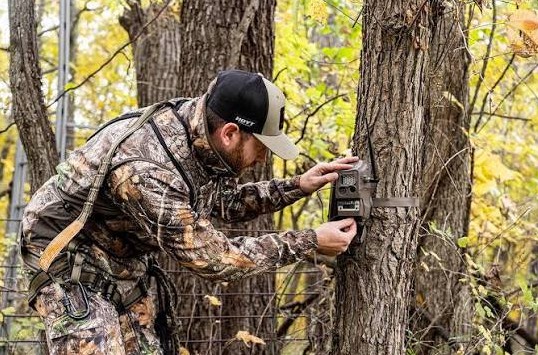
On pressured public ground, camera placement is a trade between photographs and pressure. The prettiest trail gives you the most pictures and the least useful ones.
Why does the obvious trail let you down?
Because obvious trails are obvious to everyone. They photograph does, fawns and other hunters, and they teach a mature buck that people walk there.
A camera is not free. Every visit leaves scent, boot prints and a reason for a deer to shift fifty yards. On ground with real hunting pressure, that cost is charged against you every time you check it.
So the question is not where you will get pictures. It is where a picture will change a decision. Those are different places.
Where the useful photographs come from
Terrain that forces movement: saddles, benches, creek crossings, the inside corner where two cover types meet.
| Location | Photo volume | Decision value | Pressure cost |
|---|---|---|---|
| Main trail | High | Low | High |
| Saddle or gap | Medium | High | Low |
| Creek crossing | Medium | High | Medium |
| Water in dry country | High | High in early season | Medium |
| Scrape with licking branch | Medium | High in pre rut | Low |
A saddle photographs fewer deer than a trail and tells you far more, because a deer using a saddle has committed to crossing from one drainage to another. That is a decision you can hunt.
- Face the camera north where you can, so sunrise and sunset do not wash the frame
- Hang it higher than chest height and angle it down, which keeps it out of a deer’s eye line and out of other people’s
- Leave a gap of about twenty feet to the trail so you get the whole animal, not a shoulder
Expert tip from Nathan Kestler, Big woods editor: “In big woods I put cameras where two terrain features meet, not where the sign is loudest. Sign moves with the food. Terrain does not move at all.”
How often should you check it?
As rarely as you can stand. Every visit is a withdrawal from the same account you are trying to build.
- Hang the camera in summer and leave it alone for at least three weeks.
- Check it once at the end of the early season, in the middle of a wet day when scent dies fast.
- Leave it through the pre rut and check it once more before you commit to a stand.
- After that, stay out until you are hunting, and pull the card when you leave for good.
Deer sign and camera data answer different halves of the same question. What the ground shows you is covered in what deer sign actually tells you, and what it does not, and the two together are worth far more than either alone.
The public land rules nobody writes down
Cameras on shared ground come with etiquette and, in some states, with law.
- Do not hang a camera over somebody else’s obviously active setup
- Pull cards on the way out of the woods, never on the way in
- Take the camera home at the end of the season instead of leaving it out all winter
Several states restrict or ban cellular cameras during hunting seasons, and some restrict cameras on public land entirely. That is not a detail you want to learn from a warden. Check the current rules where you hunt: the Pennsylvania Game Commission and Utah Division of Wildlife Resources both publish theirs plainly.
Expert tip from Curt Bellamy, Public land editor: “Write your name and number on the camera. Half the cameras that go missing on public ground were picked up by somebody who thought they were abandoned.”
Everything above sits inside a bigger picture, which is how deer behaviour and hunting tactics change across the phases of the season. A camera set for the early season is rarely in the right place by the rut.
Public land editor
Curt Bellamy
Thirty one years as a range technician on Utah public land. Mule deer, high benches, and a paper notebook he refuses to give up.