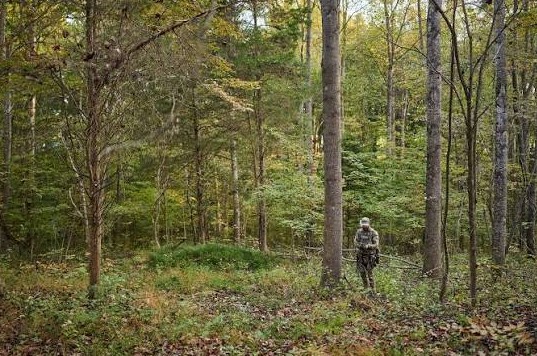
Big woods rut hunting has no field edge, no obvious food and no way to pattern one deer. What is left is terrain, and terrain is enough.
Why does farm country advice fail in the timber?
Because it assumes a food source you can see. In continuous hardwoods there is no edge to sit, and deer are not funnelled by anything a map shows at a glance.
Most rut advice is written for country where deer cross open ground to feed. Take that hunter and put him in ten thousand acres of unbroken oak, and he will sit a random trail for a week and see nothing. The deer are there. They are just not doing the thing he was told they would do.
What replaces the field edge is shape: benches, saddles, points, creek heads and the inside bends where a ridge changes direction. A buck cruising for does covers ground efficiently, and efficiency in steep country means using the same shapes over and over.
Which five shapes are worth sitting?
Learn these and you can hunt any unfamiliar ridge system on the first morning.
| Terrain | Why deer use it | Best wind | When it peaks |
|---|---|---|---|
| Saddle | Lowest crossing between drainages | Quartering into the low side | Rut |
| Bench | Level travel on steep ground | Downhill | All season |
| Creek head | Cover plus a natural pinch | Across the drainage | Pre rut and rut |
| Point | Scent checking a whole basin below | Uphill | Rut |
| Inside bend | Shortcut where a ridge turns | Along the ridge | Rut |
A point is the most misunderstood of the five. A buck standing on the nose of a ridge with a rising thermal is reading an entire basin without walking it. He is not travelling, he is checking, and he will do it at the same hour most days.
Expert tip from Nathan Kestler, Big woods editor: “If you have one morning on new ground, find a saddle and sit it. It is the highest probability guess in the big woods, and it is the only one you can make from a map before you ever walk in.”
- Contour lines that pinch together and then open again: that is a saddle
- A run of lines that spread out halfway up a steep face: that is a bench
- The last closed contour at the end of a ridge: that is a point worth walking to
Hunting the ground instead of a tree
In open hardwoods a stand often costs you more than it gains. Sitting on the ground gives you the ability to move with the wind.
There is no cover to hide a climber in a bare oak stand in November. Meanwhile the wind swings twice a morning as the thermals turn over. On the ground, against a trunk wider than your shoulders, you can shift forty yards in two minutes and stay in the game.
- Set up where you can see uphill, because deer will come from below on a morning thermal
- Put something solid behind you and nothing behind that, so your outline dies against the trunk
- Pick a spot you can leave quietly, not just one you can reach
Expert tip from Curt Bellamy, Public land editor: “Thermals beat wind forecasts in steep country. For the first hour after sunrise the air is still falling downhill, whatever your phone says at the trailhead.”
A week that worked, and why
The short version: three sits, two moves, one deer, and none of it involved sign.
- Sat a saddle on a west wind, saw two does and no buck movement after nine.
- Moved to the bench above it the next morning to get the thermal right, saw a young buck cruising downhill.
- Moved again to the point at the end of that bench and sat it from first light.
- The buck came up the nose at 8:40 to scent check the basin, exactly where the shape said he would.
None of that came from rubs or scrapes. It came from reading contour lines, which is a different skill from reading what deer sign tells you on the ground, and in big woods it is the more reliable of the two.
The rut is one phase of a longer arc. What comes before and after it is covered in our guide to the phases of the deer season and how tactics change through them.
Big woods editor
Nathan Kestler
Cruises timber for a living and hunts the same ridges on his own time. Open hardwoods, nothing to hide behind.